A 30,000-household needs assessment under access constraints
Northern Nigeria Multi-Sector Needs Assessment, 2026 · IMPACT Initiatives (REACH)
- My role
- Research lead for the assessment; led and supported a team of three
- Scale
- 30,544 interviews (27,333 after cleaning) · 11 states · 170 LGAs
- Partners
- 22 organisations · 1,000+ interviews a day at peak
- Tools
- R · Python · KoboToolbox · R Shiny
The challenge
A Multi-Sector Needs Assessment (MSNA) is a large household survey whose findings help decide where humanitarian aid goes. In 2026 the northern Nigeria MSNA had to reach displaced people, refugees and host communities across 11 states, where insecurity put large areas out of reach, with 22 partners collecting more than 1,000 interviews a day at peak.
What I did
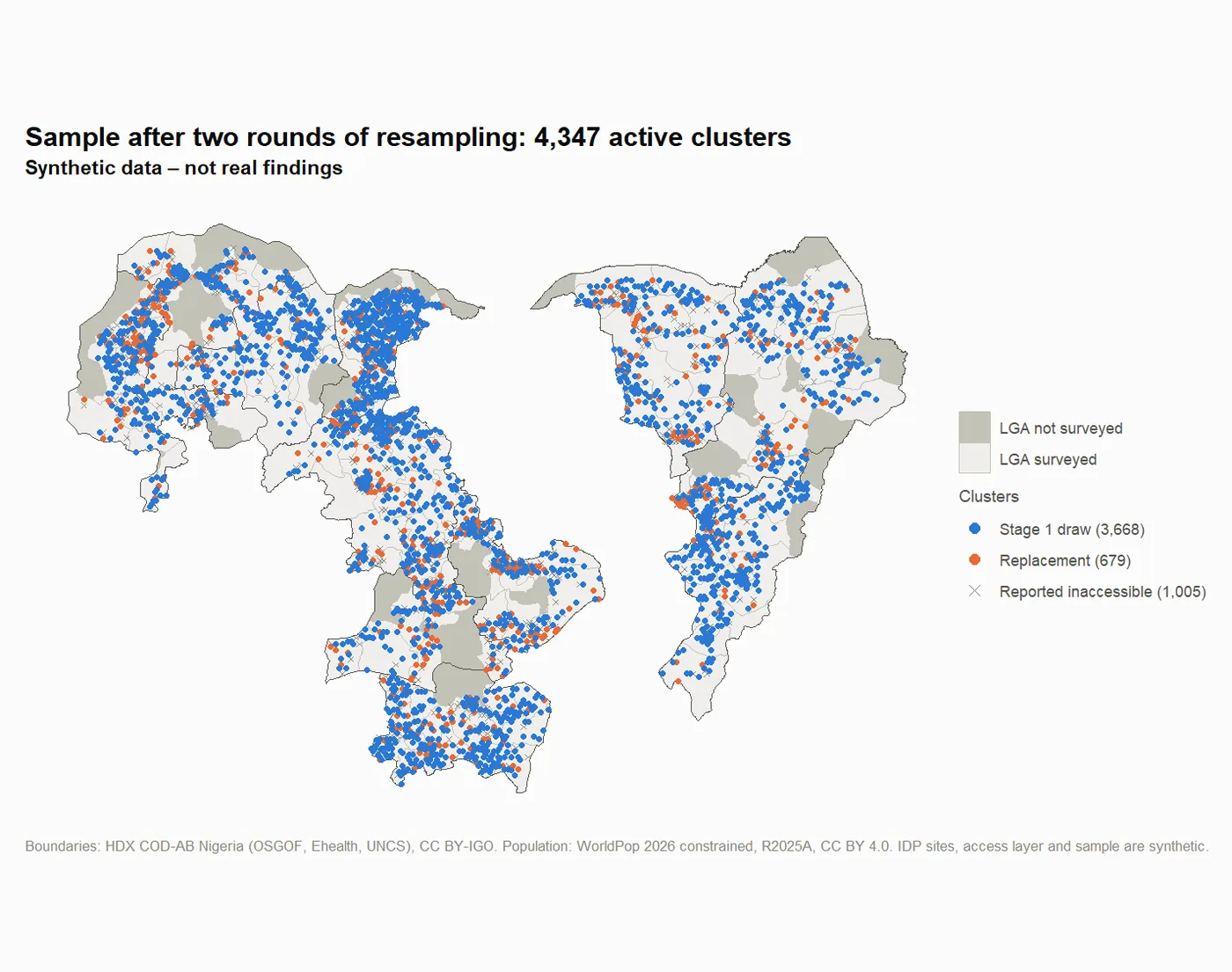
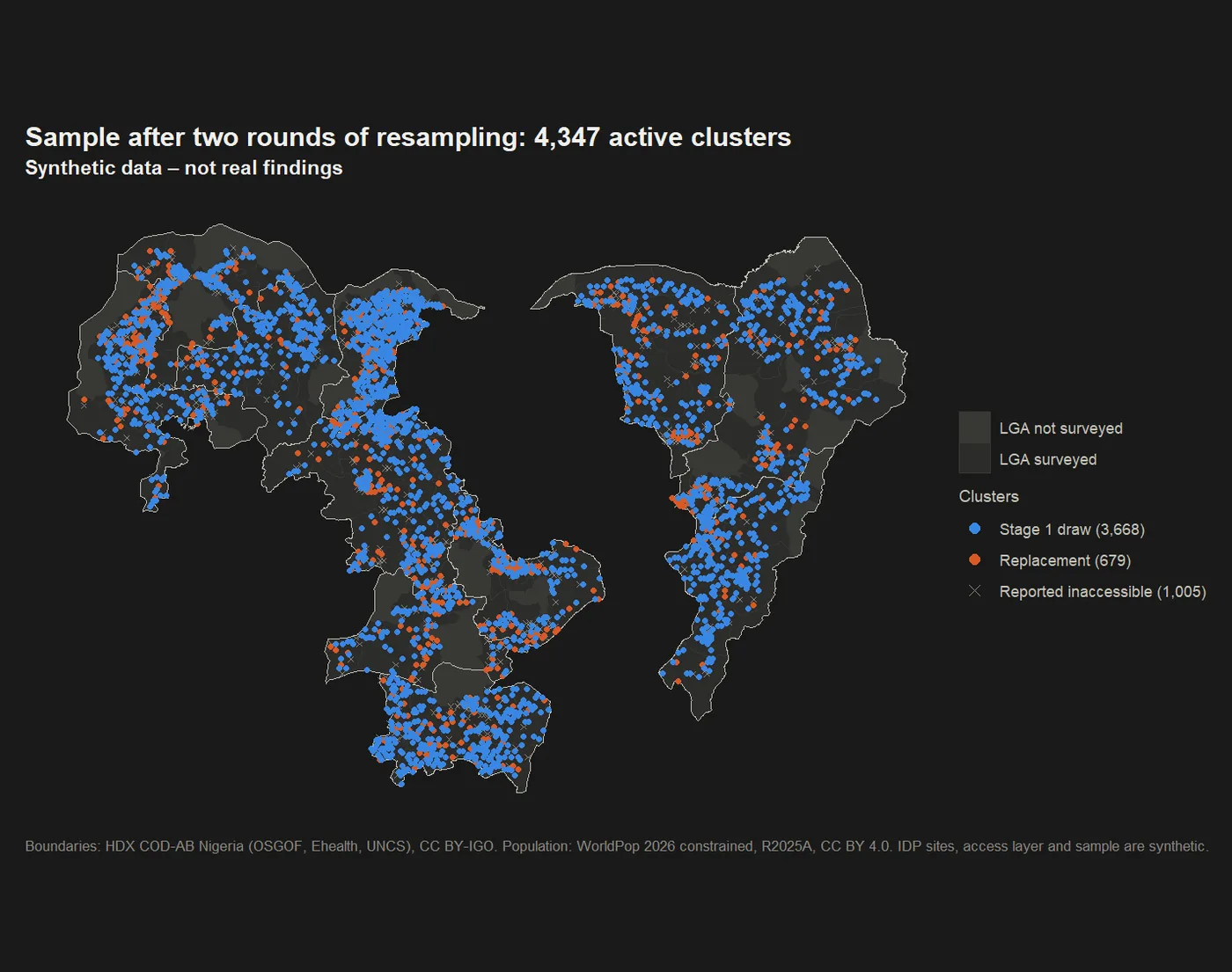
- Sampling: designed a two-stage cluster sample that kept coverage despite insecurity, and a resampling process that replaced unreachable clusters during fieldwork without breaking the design.
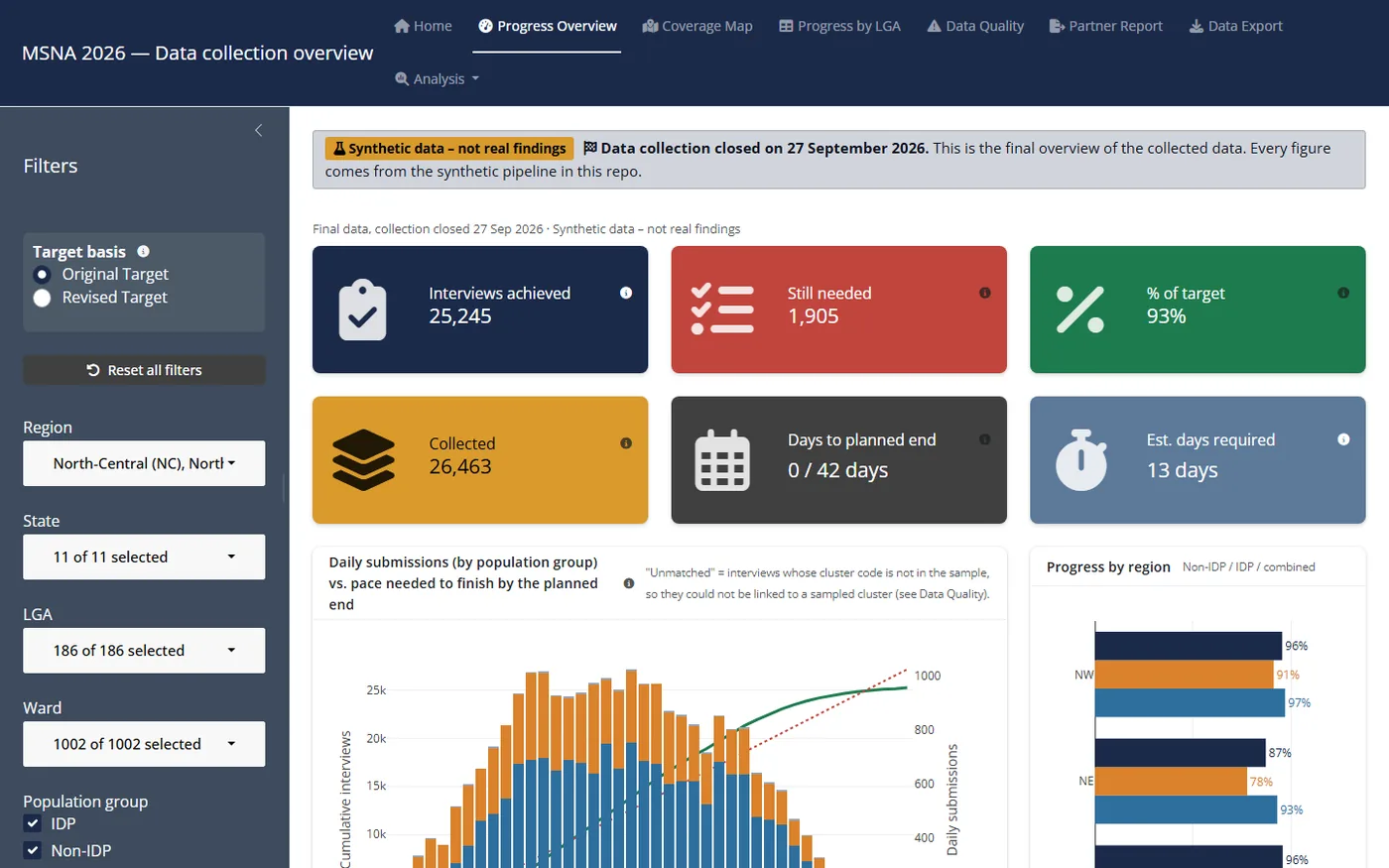
- Monitoring and cleaning: built an automated R and Python system that checked every submission, with peaks of more than 1,000 a day, with cleaning logs, a follow-up list for each partner and a live progress dashboard.
- Partners and government: worked with 22 data-collecting organisations on access, resampling and data quality; the assessment ran in coordination with Nigeria’s National Bureau of Statistics.
- The full cycle: took the assessment from secondary data review and methodology to analysis and published results.
Outcome
- Findings presented to Nigeria’s Cadre Harmonisé food security analysis, to 30+ partner organisations in a half-day workshop, and to donors (November 2026).
- Each stage rebuilt as a public, runnable repository on synthetic data, so the methods can be seen without exposing survey data.
Links
- Live dashboard demo (synthetic data)
- msna-pipeline: how the stages fit together
- msna-sampling: sampling and resampling
- msna-monitoring: monitoring, cleaning and the dashboard